
You don't need the exact figure to decide on a bowl of noodles. You need to know whether it costs about $3 or about $30. Round the rate until the sum is easy and accept being a few percent out.
Pick a shortcut that fits the rate
These are example rates to show the method. Look up the real one before your trip and adapt the shortcut.
| Rate | Shortcut | Example |
|---|---|---|
| 1 EUR = 1.08 USD | Add 10% | €40 is about $44 (exact: $43.20) |
| 1 GBP = 1.27 USD | Add a quarter | £20 is about $25 (exact: $25.40) |
| 1 USD = 0.79 GBP | Take off a fifth | $50 is about £40 (exact: £39.50) |
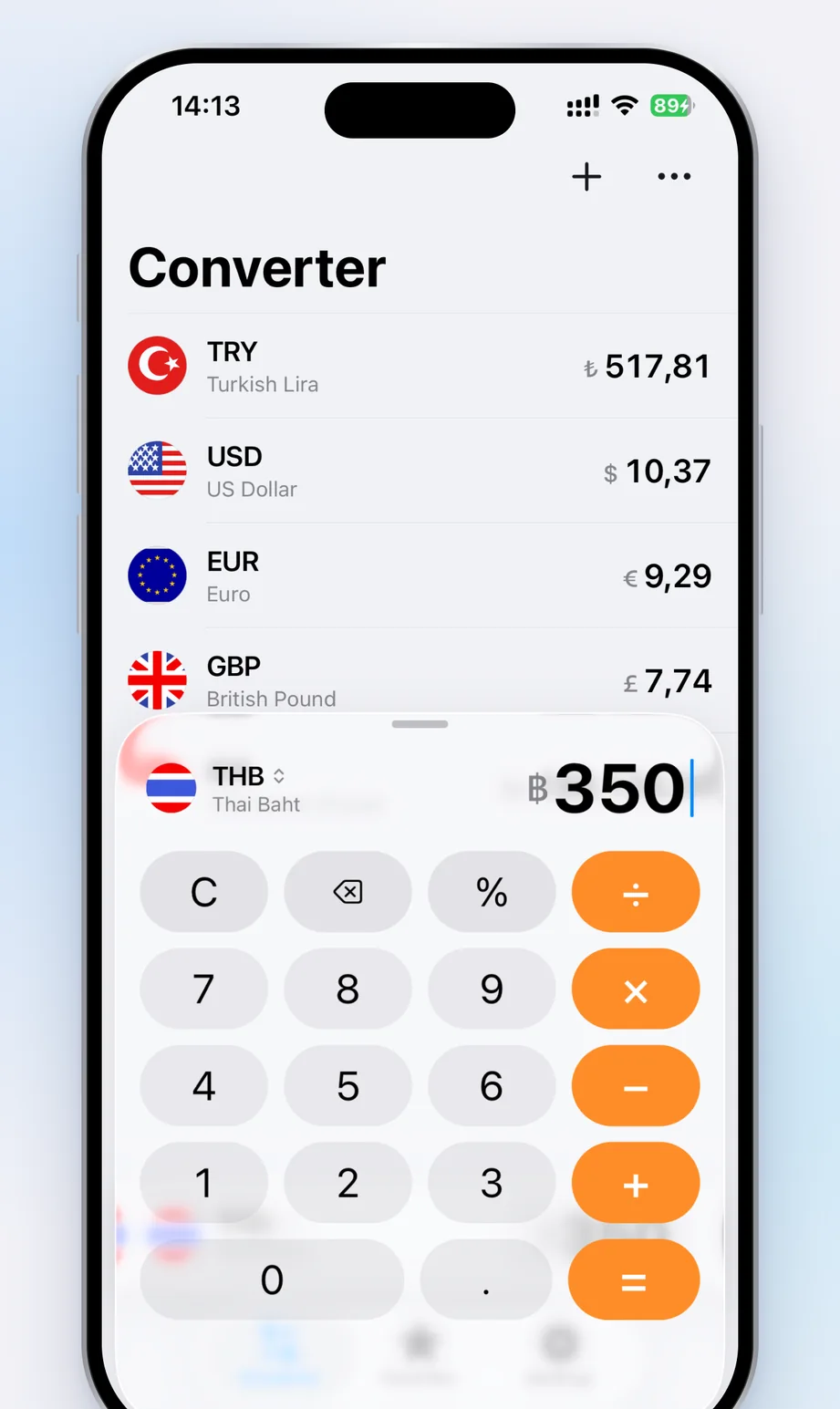
| 1 USD = 33.75 THB | Every 100 baht is $3 | 350 baht is about $10.50 (exact: $10.37) |
| 1 USD = 25,000 VND | Every 100,000 dong is $4 | 350,000 dong is $14 |
Learn three prices before you go
Convert three round amounts in the local currency, such as 100, 500 and 1,000, and remember what each is worth at home. Most prices you meet will sit near one of them, so a 480 on a menu reads as "a bit under my 500" without any arithmetic.
Watch out for big numbers
Currencies with lots of zeros are the easiest to misjudge, in both directions. 188,134 Indonesian rupiah sounds like a lot, and it was worth $10.37 at the rate in our screenshots. Tired travellers also mix up similar-looking notes, so check the zeros when you pay.
When to stop estimating
A few percent of a coffee is nothing. A few percent of a hotel bill or a car hire is real money, so use exact figures there. Currency Converter has a calculator inside the converter: add up a bill, work out a tip with the % key, divide by the number of people, and see the result in every currency on your list.
Mental maths won't show you hidden markups. For those, see what to choose when a card machine offers your own currency.